|
1
|
|
|
2
|
- Introduce IWPC
- Interesting Numbers
- Top level look at various wireless markets
- Custom vs Commodity Components
- Paradigm Shifters
- Your Ultimate Customer
- Conclusions
|
|
3
|
- IWPC ™ founded April, 1998
- 105+ Corporate Members, worldwide, growing monthly,
representing ALL layers of the wireless industry supply chain
- 10,000’s wireless industry contacts, worldwide
- Completed more than 40 workshops, worldwide, to date,
on “all-things-wireless”
- 7 on-going active discussion groups
- Active Wireless Industry research in China
- 10+ events planned for 2004,
for numerous wireless applications and packaging technologies
- IWPC Asia ™ founded, 2003
|
|
4
|
- The Consortium is a pro-active organization of WIRELESS and RF PRODUCT
OEM's and their SUPPLIERS. Our mission is to facilitate communication up
and down the supply chain, to:
- Identify and Clarify New Markets and Products/Services
- Reduce Costs
- Improve Performance
- Decrease Time to Market
- ... with an emphasis on packaging and interconnect technologies.
- IWPC Definition of "Wireless Packaging":
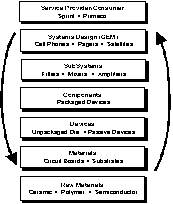
- The physical embodiment of an electronic circuit at all levels,
from device(s) up through the system,
from the Intermediate Frequency section (IF) through and
including the antenna.
|
|
5
|
|
|
6
|
|
|
7
|
- Wireless technology is used to capture and deliver voice and data
into/out-of networks
- This is known as “the access layer” of the network.
- Compared to the metro and transport layers of networks
- Networks (range)
- Personal (mm’s to meters)
- Short range (<100 meters)
- Medium range (<1000 meters)
- Long range (> 1000 meters)
- Satellite (100’s kilometers)
- For applications:
- Person to person
- Person to machine
- Machine to machine
- (potentially 10’s to 100’s billions “machines” to connect to the
network –
Lou Gerstner has said “trillions”)
|
|
8
|
- Frequency (100’s Mhz to 100+ Ghz)
- Air Interface Protocol (alphabet soup)
- Data rate (kbps to 100’s mbps)
- Power (Tx, Rx) (microwatts – 10’s watts)
- Volume (100’s to billions)
- Cost (penny’s to $10,000+’s each)
- Size (chip size to cabinet size)
- Weight (grams to tons)
|
|
9
|
- 6,330,662,787 people, world population, 2003, Nov 18
- ~90 million households, US
- By 2007, there will be ~2.7 billion handsets in use in the world (Source:
Turner Broadcasting)
- ~30 million Bluetooth ™ chipsets shipped to date (Source: Cambridge
Silicon)
- ~80% GSM % of cellular wireless market, worldwide
- In 2000, Television sets per 1000 people: China – 298, Finland – 692, United
States – 830 (ITU)
- In 2003, worldwide market for telecom equipment, $300B; telecom
services, $1,070B (ITU)
- In 2003, 650 million personal computers in use, 650 million internet
users (ITU)
- In 2002, consumers paid $1+B for ringtone downloads
- In 2003, Nokia owns ~38% of handset market share, worldwide
- Microsoft Corp. is enabling 35+ Handset manufacturers, worldwide
- ~35% - percentage of worldwide handsets mfgr’d in China, 2003
- ~120,000 base stations installed in the US
- Handset market -- ~$30 billion/year (bill of materials costs)
- Infrastructure market -- ~$2 billion/year (bill of materials costs)
- Fast internet represents ~3% of the bandwidth and 15% of the revenues
and HDTV represents ~15% of the bandwidth and <3% of the revenue
(Source: Brian Roberts, CEO, Comcast)
- HDTV data rate - ~19 MBPS uncompressed
- Voice data rate - ~ 28 KBPS
- 3G data rate: 2MBPS shared –
typically, 150-350 kbps
- Broadband data rates: from 128
kbps (UK) to 100 mbps (Korea)
- Starting 2006, all returned handsets, are the responsibility of the
handset manufacturer
- 377 – characteristic impedance of air
|
|
10
|
- RF IDs (passive and active, mm range to 100’s meter range)
- Voice and data devices (handsets,
PDAs, etc)
- Low, medium, high end devices
- Short range radio devices
- WLAN, 802.11x, (1-54 mbps)
- Bluetooth (~1 mbps, < 100 meters)
- ZigBee, 802.15.4x, (20-250 kbps, 10-75 meters)
- Low power radios
(garage door openers, key fob radios) (10’s-100’s kbps)
- UWB, 802.15x, (up to 600 mbps, <<100 meters)
|
|
11
|
- Base Stations
(ground based and tower top for mobile, portable & fixed
applications)
- Personal (~10’s meters, aka access points)
- Pico (~10’s meters)
- Micro (~100’s meters)
- Macro (1000 meters)
- Competing with:
- Twisted pair (xDSL)
- Coax cable
- Fiber
- Power line
- Antennas (fixed, steerable, smart, many other configurations)
- Repeaters (network, personal, in-building coverage extenders)
- Last-mile broadband (fixed and portable applications)
(proprietary standards, 802.16x, 802.20x)
- Satellite (special case of frequency, range, power)
|
|
12
|
- Point to point radios (*) (short and long range)
- Point to multi-point radios
- Cellular Backhaul radios
- Satellite terminals
- Automotive Radars and Sensors
- Sensors (eg: thru-wall security)
- (*) FCC just released 71-86 GHz and 92-95 GHz bands for gigabit data
rate radio applications
|
|
13
|
- Inside the vehicle
- Vehicle to vehicle
- Vehicle to roadside
- Vehicle to satellite
- Convenience (ex: curb/child detectors)
- Safety (ex: Interactive adaptive cruise control radar)
- Emergency (ex: air bag deployment signal)
- Entertainment (ex: audio, video, info-fueling)
- Maintenance (ex: time for an oil change)
- Customer relationship management
- Location based services
- Many other applications…
- Forecast:
- Future vehicles will need to manage up to 18 different frequencies
- In 2003, Mercedes tells us that electronics represents 50% of the
automotive bill of materials
|
|
14
|
- EMS procurement experts tell us that they prefer to order commodity
components vs custom components
- Reason – EMS’s don’t want to be stuck with un-used inventory of custom
components that they can’t use for a other projects
- EMS’s get 6 month rolling customer production forecast, with <1
month order commitments
- This un-used “custom inventory” could put a big bite into the razor
thin margins of EMS’s
|
|
15
|
- Global war on terror
- EMS/ODM growth – who is the customer?
- Software definable/configurable radios
- Fuel cells
- 24 hour per day design, development & manufacturing cycles through
globalization of resources
- Full use of the WEB for communication, development, design,
manufacturing, sales, support.
- Increased global pressure for ecologically sound practices.
|
|
16
|
|
|
17
|
- Packaging requirements for wireless applications:
- Cost, cost, cost
- Time to market
- Reduced size, weight, volume
- Increased cost effective integration
- Reduce power consumption
- Cost, cost, cost
- Time to market
- And finally, a roadmap to ongoing cost reduction…
- Which wireless markets will your company, your products or you, support
in the future?
|
|
18
|
|

 Notes
Notes